Introduction – This Month Under the Stars
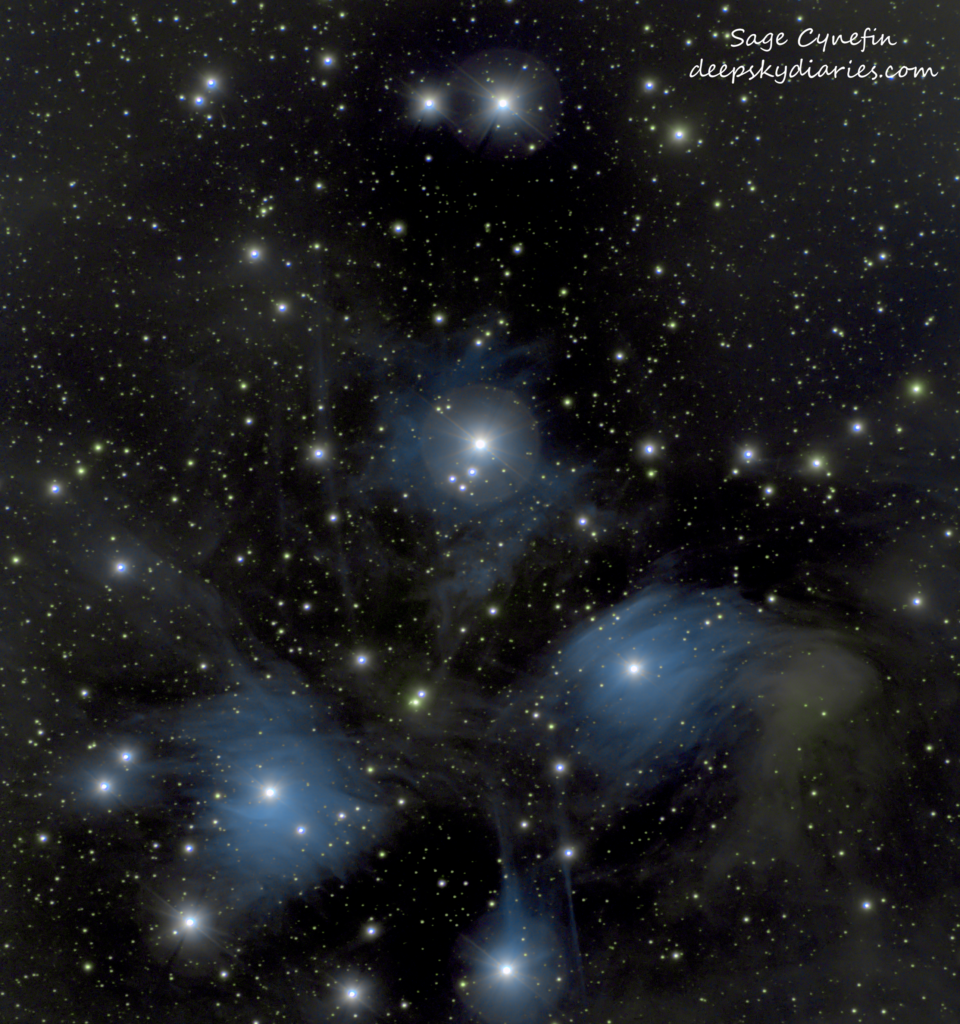
My educational focus this month was on optics. Topics in my studies focused on the functions of a telescope and how they form an image. Additional topics include how that image is sorted, filtered, and analyzed after the light has been collected. With the Taurus, but more specifically M45 Pleiades star cluster, in the north-eastern sky, I took an opportunity to image this target on a particularly clear night. It was clear but I could feel the late fall weather setting in and decided to invest in warmer clothes. My second field night was more comfortable, though the data proved more difficult to process than anticipated, likely due to the filter used. It was a good month with two good field experiences. Here’s hoping I make it through these long cold winter nights in the field.
Study Focus- What I learned
Topics of self paced study this month have covered the science, history, and future of telescopes on, and off, Earth. Telescopes come in two varieties, refractors, the older design, and reflectors, new mirror based designs such as my schmidt cassegrain telescope. Learning the physics behind the optics of my telescope allowed me to appreciate how an image is focused and formed at a specific distance from the entrance of the tube. Ensuring proper backfocus distance is critical to obtaining a sharp image, and therefore usable data. Introduction of structured math to my self developed and ever evolving curriculum plan has me reviewing the basics of algebra before diving deeper into more advanced topics to review.
Observing Log Highlights – Nights in the Field
First target of the month was the Pleiades Star Cluster (M45) using my Celestron 9.25″ SCT mounted on the ZWO AM5N and TC40 tripod. Hyperstar was installed in place of secondary mirror using Fastar compatibility. ZWO ASI533MC Pro was mounted to Hyperstar ensuring snug, but not overtightened fit. Power and data cords routed to ASIAIR mounted to top rail of telescope tube. Power and data cords run from ASIAIR to AM5N with slack removed to prevent snags. Main 15a power cable routed from ASIAIR to AC inverter strapped to tripod then to Jackery Explorer power station. Power station turned on, AC ports enabled, ASIAIR powered on, mount powered on. Connected iPad to hotspot wifi and entered ASIAIR through station mode. Focal length set for main camera, no tracking tonight so no guide scope focal length. Polar aligned without difficulty. Vega centered and focus manually acquired and then fine tuned with Bahtinov mask. M45 found, verified centered and set up plan for 8 hours of light frames. Began imaging target for almost two hours before becoming too cold to stay out.
Second target of the month was the Triangulum Galaxy (M33) using standard equipment as well as Hyperstar, Optolong L-Extreme filter (I admit, I forgot these are best for emission nebula, lesson learned), and dew shield was prepared but not installed leading to an inability to properly obtain flat frames and loss of the final 20 minutes of light frames. Equipment was set up and assembled in standard fashion for this configuration. Polar alignment performed with some difficulty due to recent install of electronic autofocuser improperly causing mirror flop. Focus was obtained at home position, but when rotating the RA axis significantly to obtain polar alignment, it was no longer in focus. Corrected by manually recentering focus knob in housing with little success. Still losing focus on movement. Obtained sharp focus at home position, rotated RA axis and refocused. Did not lose focus aside from those caused by temperature changes the rest of the night. Will monitor during future field experiences. Autoguiding calibrated in eastern sky near celestial equator. Target centered and framed. Autoguiding enabled and began data collection. Performed manual meridian flip. Finished collecting data until dew formed. Attempted to obtain flats knowing they were likely unusable. Equipment packed out in standard fashion.
Technical Notes & Lessons – Tinkering and Troubleshooting
This month I learned that personal warmth and comfort require investments in layers in order to stay out with my telescope in the field. Aside from that, I also learned that I have not developed the skills necessary yet for a filter such as the Optolong L-Extreme, and will stick to the UV/IR filter for now. Additionally, Pixinsight is a wonderful software tool for sorting, calibrating, aligning, stacking, integrating, and editing all in one place. With a total of 836 images between light, dark, flat and bias frames, I was able to learn how to do all of those things as well as some other processes such as dynamic background extraction. Future learning projects for myself will include image processing using python scripts, so stay tuned for that. During my second field night, I tried my hand at autoguiding and found it to be much more intuitive than expected. Future nights will focus on improving autoguiding in order to capture longer and longer exposures. With autoguiding, I was able to capture 120s exposures of M33 Triangulum Galaxy with stunning results.
Showcase – Image of the Month
M45 The Pleiades Star Cluster
- Focal Length: 517mm at f/2.2 using Hyperstar
- Total Integration: 1 hour 35 minutes 20 seconds
- 286 20s light frames at 110 gain
- Calibration frames: 50 dark frames 200 flat frames 300 bias frames
- Pixel Scale 1.5″ x 1.5″ per pixel
- Processed, stacked, aligned, integrated, stretched in Pixinsight, final edits in Photoshop
Reflection- Looking Up Ahead
Next month brings new challenges as I begin to review python basics, begin working on python projects, and learning more about the data analysis side of astronomy. There will still be major focus on photography basics, but as I work towards citizen science projects, it is important to understand how computer science aids in the processing of large amounts of data. This blog will continue to document this journey as it changes perspective from just some woman and her telescope towards that of someone looking to transition career fields. Thank you for joining me on this journey, please remember to subscribe below for notifications on current projects, when new posts are published, and any other announcements I may have.