This Month Under the Stars
Welcome to my very first post in this adventure. October was only a partial month of dedicated study. Most of the time I have to dedicate to this hobby occurs on the weekends, so progress may be slow. In addition, observation sessions are planned at a rate of 1-2 nights a month depending on weather of course. Speaking of weather, this month has been cloudy and rainy, unfortunately, and of course a ton of wind came with it. That did not stop me from getting out there a couple nights! My first night out, it was very windy but I am persistent and stubborn so I set up my scope anyways and attempted to get some images. This month, I also picked up a Hyperstar to improve my pixel scale as well as decrease the amount of time needed for exposures. With this, I may be inclined to attempt more observation sessions during the week, as long as work doesn’t kill me that day. But we will see what happens! Read on to hear more about my month of October.
What I learned
This month, I reviewed chapters 1-4 of OpenStax Astronomy 2e with particular focus on chapter 4 regarding the Earth’s motion, the sky’s apparent motion, tracking time, and the major focus this month: Lunar cycle and phases of the Moon. Fun fact, if you didn’t know, the dark portion of the moon that we see contrary to popular belief, is not the shadow of the Earth (as I also believed until now, oops), but instead is the unilluminated portion of the Moon as it rotates around the Earth. The Sun shines from a constant relative direction towards the Earth and Moon and as the Moon revolves around the Earth, half of it is illuminated at any given time. The angle at which we see this illuminated half is constantly changing as the Moon goes around the Earth. The Moon’s sidereal period, or the measurement of the Moon’s revolution around the Earth with respect to the stars, is exactly 27.3127 days, while the interval for phases to repeat is the Solar Month at 29.5306 days. This is due to the Earth’s movement around the Sun. As the Moons travels around the Earth, it must rotate more than one full rotation in order to return to the same phase with respect to the Sun.
This really helped me gain an appreciation for the most prominent feature in the night sky, our moon, Luna. Not only that, but it has affected how I schedule observation sessions. With my keen interest in deep sky objects for photography, I know now that the best time to image is during the new moon while the Moon is illuminated at 0% as well as being on the same side of the Earth as the Sun and therefore, not present in the night sky. Luna is wonderful, beautiful, and worthy of celebration. Despite this, I aim to avoid her as much as possible in my hunt for deep sky objects.
Nights in the Field
In the month of October I was able to squeeze in two observation sessions. The first was very windy and I did not get great results. The second, on October 21st I made a snap decision to go out and image for a couple hours on a Tuesday despite having to work in the morning. This session was much more successful. Seeing and transparency conditions were as good as I think they will get for this location. Being just outside the city, the glowing sky to the East was very bright, however most of the sky is dark enough to just see the shadow the the Milky Way stretching across the ecliptic.
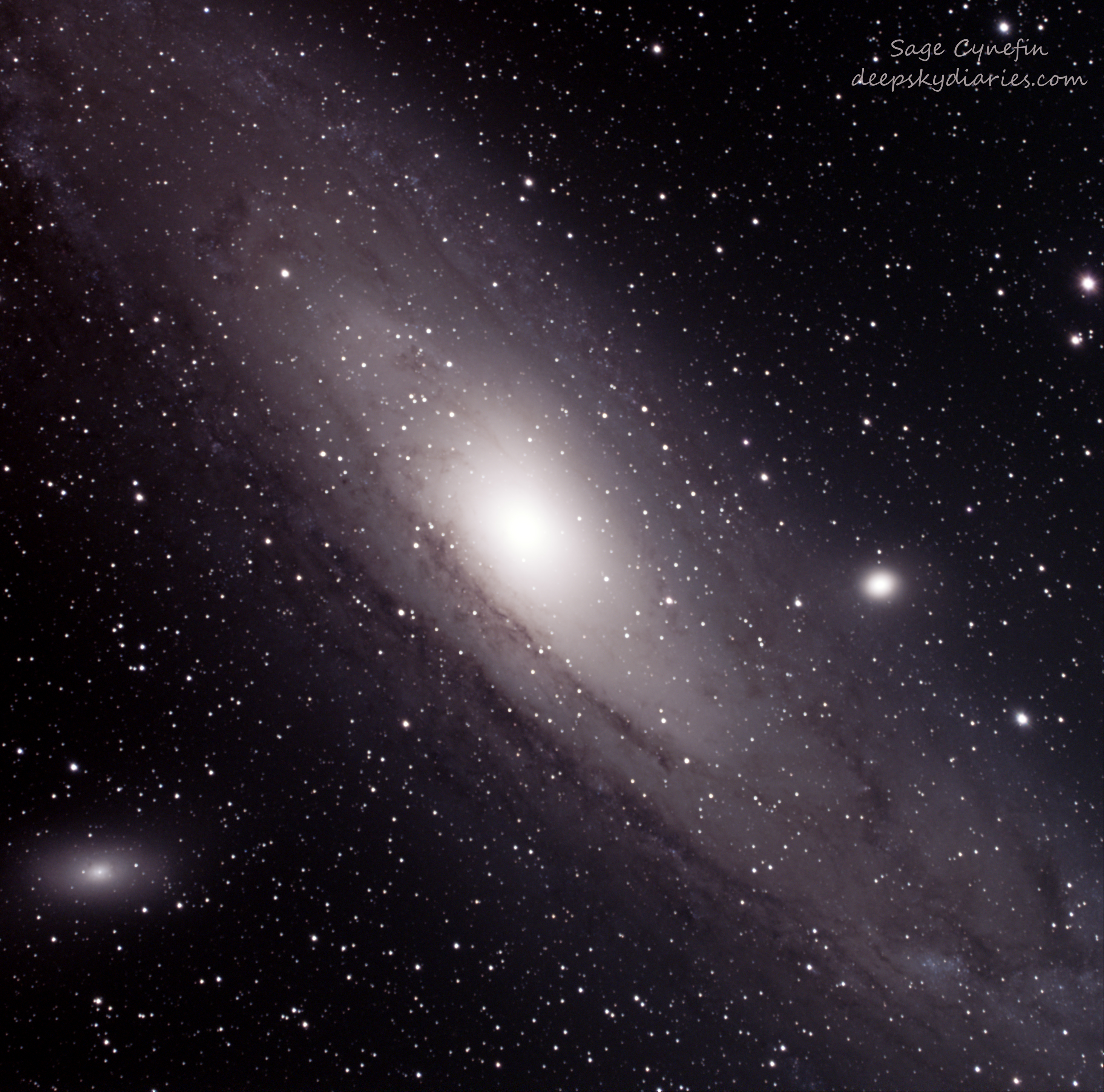
It was a cold and still night without the Moon in the sky. I tested out my new hyperstar and was blown away by the results. A wide field shot nearly large enough to fit the entire Andromeda Galaxy within the frame. Using the Hyperstar on my Celestron NexStar Evolution 9.25″ SCT and AM5N mount, I was able to collect an hour of data on the Andromeda Galaxy. I did not use guiding this session and simply re-centered the target every so often to account for drift. I assumed stacking software would even out the drift and still get lots of good data on the main body of the galaxy. After stacking and some mild editing work, I must say it is absolutely beautiful and I cannot believe I was able to capture such an incredible image just a couple of months into really learning how to use a telescope and astrophotography equipment.
Tinkering & Troubleshooting
The hyperstar system was the newest piece of equipment. I believe this will be the most valuable piece of equipment I have purchased. It will be great for wide field imaging of large objects as well as collecting lots of data very quickly due to its focal ratio of f/2.2 vs the native ratio of the telescope of f/10 or the Celestron Focal Reducer’s ratio of f/6.3. It will not be used for every target. Therefore, I have much to learn still at other focal ratios such as off-axis guiding, use of filters, and more complex targets with longer integration times.
Image of the Month
My “Image of the Month” is M31 the Andromeda Galaxy. It is a stacked image of 180 20s subs and edited in photoshop. Total integration time was 1 hour. This was the first real results I have had with my telescope since I began this journey and I must say the results are stunning.
Details:
- Telescope: Celestron NexStar Evolution 9..25″ OTA
- Mount: ZWO AM5N + TC40 tripod
- Camera: ZWO ASI533MC Pro one-shot color camera
- Shot using Hyperstar at f/2.2
- FOV approx. 1 degree x 1 degree
- Stacked 180 subs of 20 seconds each
- Total Integration 1 hour
- No guiding
Looking Up Ahead
November I will start to really focus on deep sky imaging. The past couple of undocumented months have exposed me to the basics, despite having advanced gear. I tend to jump in a bit deeper when I get into hobbies and learn the basics while also challenging myself to be more than basic. My plan for next month’s observation sessions will include the popular winter targets, and my favorite (for now) nebula and star cluster, M42 Orion Nebula and M45 Pleiades Cluster. I have not begun the planning phase of observation for these target so depending on their apparent sizes I will either image using the hyperstar again, likely as I do believe these are fairly large targets if I remember correctly, or I will use the Celestron f/6.3 focal reducer and try my hand at off axis guiding now that I have a bit more observational understanding and am beginning to learn my own work flow. As is the plan with all blog posts, each month will be reviewed and the post for that month will be available on the final day of the month. Don’t forget to subscribe to get an email every time I post! Thanks for reading.